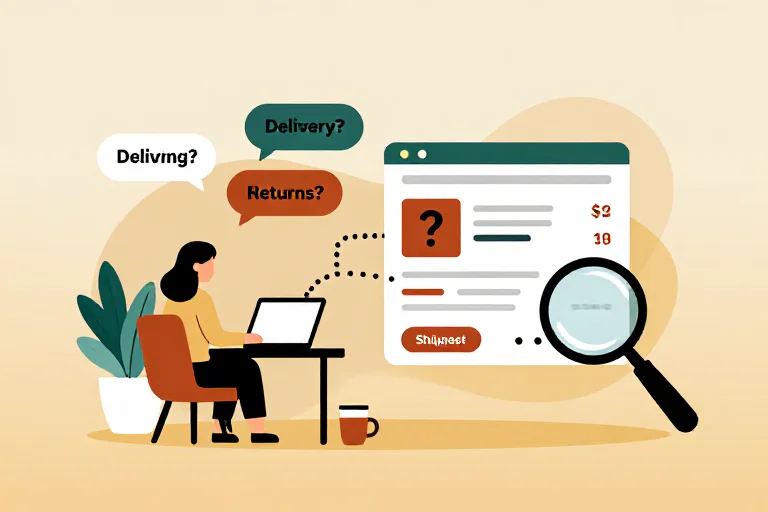
How to Reduce Cart Abandonment Without Fixing the Wrong Problem

Synmentis
If you're searching for how to reduce cart abandonment, you probably already have the number.
Maybe 70%.
Maybe 75%.
Maybe even higher.
And then the usual advice starts coming at you:
Add a cart recovery email.
Offer free shipping.
Add more payment methods.
Use a discount.
Make checkout shorter.
Add trust badges.
Try a popup.
Some of these can help.
But there is a problem with starting from the list.
You don't know which problem your shoppers actually have.
And that matters because an abandoned cart doesn't always mean the same thing.
Someone can leave because shipping is too expensive.
Someone else can leave because they were never ready to buy.
Someone can leave because the delivery date is too late.
Someone can leave because they were comparing two products.
Someone can leave because your checkout is painful.
Those shoppers all end up in the same metric:
Abandoned.
They shouldn't all get the same fix.
First, understand what cart abandonment actually tells you
Cart abandonment means a shopper added something to their cart but did not complete the purchase.
That's useful.
But it's not a diagnosis.
Baymard's recent checkout UX research makes an important distinction here: a significant share of abandonment comes from factors such as price comparison, browsing without purchase intent, or delivery costs, while another portion is caused by friction that merchants can actually remove.
That means the first question shouldn't be:
"How do I recover this cart?"
It should be:
"Why did this shopper leave?"
That sounds obvious.
It's also the step most cart-abandonment strategies skip.
Don't assume 70% abandonment means you lost 70% of your sales
This is important because cart abandonment numbers can make a store owner panic.
Current ecommerce benchmarks put average abandonment around 70% or higher, depending on the dataset and how the metric is defined. Stripe currently cites roughly 70% across ecommerce, while Shopify cites 77% from its referenced Dynamic Yield dataset.
That sounds terrible.
But a shopper can put something in the cart without being ready to buy.
They may be:
- checking the final price
- comparing products
- checking shipping
- saving something for later
- waiting for payday
- looking at several stores
- simply browsing
Recent ecommerce discussions make this distinction surprisingly often. People put things in carts as part of the research process, not only because they have already decided to purchase.
So don't set yourself the goal of converting every abandoned cart.
Set yourself the goal of removing the avoidable abandonment.
That's a much more useful target.
How to reduce cart abandonment: start where the uncertainty appears
The easiest way to make this practical is to follow the buying journey.
Think about what happens between:
Product → Cart → Checkout → Purchase
At each step, a different kind of problem can appear.
1. Show the real cost before the final step
This is one of the most common problems.
A shopper sees:
$79
They like the product.
They add it to the cart.
Then they see:
Shipping: $18
Suddenly the purchase feels different.
The problem isn't necessarily that $18 shipping is unreasonable.
The problem is that the shopper discovered it too late.
Baymard's 2026 research identifies additional costs such as delivery charges and taxes as the leading checkout-related reason in its survey, with 39% of respondents citing this type of issue.
So one of the simplest ways to reduce shopping cart abandonment is:
don't hide the important part of the price until checkout.
Make it easy to understand:
- shipping cost
- tax treatment
- minimum order requirements
- free-shipping thresholds
- other unavoidable fees
You don't necessarily need to make everything free.
You need to make the cost predictable.
There's a big difference.
Bad:
Free shipping on orders over $100
with no indication of the shipping cost for smaller orders.
Better:
100 Free shipping over $100
Now the shopper can make the decision with the real information.
2. Don't make the cart reveal something the product page should have explained
This is another version of the same problem.
A shopper shouldn't have to reach the cart to discover basic purchase information.
For example:
Delivery: 7–10 business days
Ships from overseas
Final price excludes tax
Only available in selected regions
These aren't checkout details.
They're purchase-decision details.
If they're important enough to change the decision, they belong earlier.
This is one reason product-page clarity and cart abandonment are connected.
A store can have a perfectly functional checkout and still have high abandonment because the product page left too many unanswered questions.
That's why I would look at ecommerce product page optimization before assuming the checkout itself is broken.
3. Make delivery timing specific
"Fast shipping" sounds good.
It isn't very useful.
A shopper who needs a product by Friday doesn't care that your shipping is generally fast.
They care whether it will arrive by Friday.
Current Stripe research lists slow delivery among the common drivers of cart abandonment, while recent ecommerce discussions repeatedly mention delivery timing as a decision factor.
So instead of:
Fast and reliable shipping
give the shopper something closer to:
Order today — estimated delivery Thursday–Saturday
That reduces uncertainty.
And if the product won't arrive in time, the shopper can make that decision before spending five minutes in checkout.
That's actually better for both sides.
4. Don't force shoppers to create an account
This one has been discussed for years.
It is still a problem.
Baymard's current research reports that 19% of surveyed shoppers abandoned checkout because they were required to create an account.
The important thing isn't that "guest checkout is a magic conversion hack."
It's that you're asking the shopper to do something that isn't necessary for the purchase.
The shopper is thinking:
"I just want to buy this."
Your site says:
"Create an account first."
That's an unnecessary negotiation.
Let them buy.
You can ask whether they want an account after the order is complete.
5. Count how much work your checkout creates
A checkout can be technically correct and still feel exhausting.
Name.
Email.
Phone.
Address.
Company.
Birthday.
Password.
Marketing preference.
Survey.
Account creation.
Verification.
Another page.
Another confirmation.
And eventually:
Pay now.
Every step is another chance to stop.
Shopify's current ecommerce UX guidance points to checkout length and complexity as another significant source of abandonment, while its 2026 checkout guidance emphasizes reducing unnecessary steps and fields.
So don't ask:
"How many fields should a checkout have?"
Ask:
"Why does the shopper need to provide each of these?"
If there's a genuine reason, keep it.
If nobody on the team can explain why the field exists, that's a good candidate for removal.
6. Make payment feel normal
Payment is a strange moment in the customer journey.
The shopper has already decided that they probably want the product.
Now they're being asked to trust the business with their money.
This is where unfamiliar payment flows can suddenly become a problem.
The payment methods should match what your customers actually use.
Not every possible payment method.
The useful ones.
And the experience should feel consistent with the rest of the store.
A checkout that suddenly redirects to an unfamiliar page, changes the visual language completely, or asks for information in an unexpected way can create doubt right before payment.
The important question isn't:
"Do we have eight payment methods?"
It's:
"Can this shopper pay in a way they recognize and trust?"
7. Make returns easy to understand before the shopper pays
This matters more when the purchase carries risk.
Especially for:
- clothing
- furniture
- electronics
- expensive products
- products where fit or appearance is uncertain
Imagine a shopper thinking:
"What happens if I don't like this?"
Then they search.
They scroll.
They finally find a 900-word returns policy.
That's friction.
A simple answer can do more:
30-day returns
Free return shipping
Unused items only
Now the shopper knows what they're agreeing to.
The exact policy isn't the point here.
Clarity is.
8. Don't throw a discount at every abandoned cart
This is one of the most tempting shortcuts.
Someone abandons.
You send:
"Come back and get 10% off."
Maybe it works.
But you've also taught some shoppers:
"If I leave, the price may come down."
More importantly, a discount doesn't solve every abandonment problem.
Imagine the reason someone left was:
"I don't know when this will arrive."
A 10% discount doesn't answer that.
Or:
"I don't trust this site."
Still not solved.
Or:
"Shipping costs $25."
A 10% discount may barely change the decision.
Or:
"I was just comparing products."
The discount wasn't necessary in the first place.
Cart recovery is useful.
But recovery should come after understanding why people abandon.
9. Separate cart abandonment from checkout abandonment
This is a small distinction with a big practical effect.
Cart abandonment
The shopper puts something in the cart and leaves.
Possible reasons:
- comparing
- saving for later
- checking price
- checking shipping
- not ready
Checkout abandonment
The shopper actually enters the purchase process and leaves.
Possible reasons:
- unexpected costs
- payment problems
- account requirement
- confusing forms
- delivery problems
- trust concerns
- technical issues
Stripe and Shopify both distinguish checkout-stage abandonment from the broader cart behavior.
So don't diagnose them with the same report.
A store with lots of carts but relatively few checkout starts has a different problem from a store where many shoppers start checkout and disappear at payment.
The location matters.
10. Look at the shopper, not only the metric
This is where analytics starts reaching its limit.
Imagine your report says:
Cart abandonment: 73%
What does that tell you?
Not much.
Now imagine you can watch several shoppers and hear:
"I wanted to know the shipping cost."
"I'm comparing this with another one."
"I couldn't tell when it would arrive."
"I don't know if I can return it."
"I wasn't actually ready to buy."
Now the number starts making sense.
And notice something important:
Not all five are the same problem.
That's exactly why blindly following a cart-abandonment checklist often produces a messy website without solving the underlying issue.
11. Find patterns, not one-off complaints
One shopper saying:
"I don't like the color."
doesn't necessarily mean you need new product photos.
One shopper saying:
"Shipping is expensive."
doesn't necessarily mean you should offer free shipping.
What you want to find is repetition.
Maybe five different shoppers independently ask:
"When will this arrive?"
Now you have a stronger signal.
Maybe three different shoppers try to find the return policy before buying.
That's interesting too.
Maybe people repeatedly compare your product with another one before leaving.
That tells you something about the decision process.
The goal is not to collect complaints.
It's to identify repeated hesitation.
12. Don't optimize the cart in isolation
This is one of the biggest mistakes I would avoid.
A shopper doesn't experience:
Product page
Cart
Checkout
as three unrelated systems.
It's one buying journey.
If the product page says:
"Ships in 1–2 days"
and the cart says:
"Estimated delivery: 7–10 days"
the shopper experiences one problem.
Not two.
If the product page shows:
$99
and checkout suddenly shows:
$124
the shopper experiences one problem.
Not two.
If your product page makes a product look simple but checkout introduces six requirements, the shopper experiences one problem.
This is why reducing cart abandonment often means fixing something before the cart.
A practical way to reduce cart abandonment
Instead of going through twenty CRO tactics, I would use this process.
Step 1: Find the exact stage where people leave
Look separately at:
Product → Add to cart
Cart → Checkout
Checkout → Payment
Payment → Order confirmation
Don't throw the entire store into one bucket.
Step 2: List what the shopper had to learn at that stage
For example:
At the product page:
Is this the right product?
At the cart:
What will this really cost?
At checkout:
Can I trust this purchase?
At payment:
Can I pay normally?
This gives you a much clearer research question.
Step 3: Look for evidence
Use:
- analytics
- support questions
- reviews
- customer feedback
- recordings
- checkout errors
- real shopper research
The point is to combine evidence rather than letting one source decide the diagnosis.
Step 4: Fix the strongest avoidable problem
If shoppers don't understand shipping, make shipping clear.
If they can't tell what they'll pay, show the actual cost.
If account creation is getting in the way, add guest checkout.
If the checkout is too long, remove unnecessary work.
Don't add unrelated tactics just because they're common.
Step 5: Run the journey again
This step is often skipped.
You changed the checkout.
Good.
Now watch what happens.
Did the original hesitation disappear?
Did a different problem appear?
Did nothing change?
That's how you learn whether the fix actually addressed the reason shoppers were leaving.
What about abandoned cart emails?
Use them.
Just don't confuse recovery with prevention.
Cart recovery can bring back shoppers who were interested but left.
That's useful.
Shopify's current guidance still treats abandoned-cart recovery as an important part of ecommerce conversion, while recommending that merchants understand the reason for abandonment rather than relying only on generic reminders.
But an email saying:
"You forgot something 👀"
doesn't fix:
unexpected shipping costs
bad delivery information
a confusing return policy
a broken payment flow
a product that the shopper doesn't fully understand
Recovery works best when you're also improving the underlying experience.
Otherwise you're repeatedly trying to bring people back to the same problem.
The hardest part of reducing cart abandonment isn't the cart
It's understanding the hesitation.
That's why I don't think the most useful ecommerce question is:
"What are the top reasons for cart abandonment?"
You'll find the usual list.
Extra costs.
Slow delivery.
Account creation.
Complicated checkout.
Payment issues.
Trust.
Those are real.
But they don't tell you which one is happening on your store.
The better question is:
"What was this shopper trying to resolve before they decided not to buy?"
That question gives you somewhere to go.
What if you could actually watch different shoppers try to buy?
This is where we think AI gets interesting.
Not as another abandoned-cart email writer.
Not as another CRO checklist generator.
But as a way to research the buying experience itself.
Imagine giving different shopper profiles different goals.
One is highly price-sensitive.
One cares about delivery.
One is buying for someone else.
One is visiting the store for the first time.
One already knows exactly what they want.
One is unsure whether the product fits their needs.
Then let them experience the store.
You can see:
What do they look at?
What do they understand?
What do they question?
When do they compare?
What makes them hesitate?
Where do they leave?
That gives you a very different kind of evidence.
Instead of:
"Your abandonment rate is 72%."
You might learn:
"Three different shoppers reached the cart and stopped after discovering the shipping cost."
Or:
"Shoppers understood the product but couldn't find a clear answer about delivery."
That's much closer to something you can actually fix.
Reduce cart abandonment by removing uncertainty, not by forcing conversion
This is the part I would keep in mind.
You don't need every shopper to buy.
Some won't.
Some shouldn't.
Some are comparing.
Some are browsing.
Some aren't ready.
That's normal ecommerce behavior.
The opportunity is to remove the reasons your own store gives qualified shoppers to hesitate.
Make the price predictable.
Make delivery understandable.
Make returns clear.
Make checkout easy.
Offer familiar payment options.
Don't force unnecessary steps.
And most importantly:
Find out what your shoppers are actually worried about.
Because reducing cart abandonment isn't really about making people click Buy faster.
It's about making the decision easier for the people who are already close to making it.
And that's a much better way to optimize an ecommerce store.